In the fast-paced and competitive landscape of modern business, the ability to make smart decisions is more critical than ever. With technological advancements, artificial intelligence (AI) has emerged as a powerful tool that significantly enhances decision-making processes across various industries. This article explores the indispensable role of smart decision-making in business success and delves into the impactful contributions of AI in different sectors.
Smart Decision-Making: A Cornerstone of Business Success
The ability to make informed and timely decisions is a cornerstone of business success. Effective decision-making ensures that businesses can navigate challenges, capitalize on opportunities, and maintain a competitive edge in their respective industries. Smart decisions not only lead to increased efficiency and productivity but also contribute to long-term sustainability and growth.
The Role of AI in Decision-Making Processes
AI has revolutionized decision-making processes by providing advanced tools and capabilities that augment human decision-making. Across various industries, AI is making a significant impact, transforming the way businesses operate and make critical choices.
Use Cases of AI in Decision-Making Across Industries
- Healthcare: AI aids in diagnosis, treatment planning, and personalized medicine, improving patient outcomes and optimizing resource allocation.
- Finance: AI enhances financial decision-making through predictive analytics, fraud detection, and algorithmic trading, improving accuracy and reducing risks.
- Customer Relationship Management: AI-driven insights enable personalized customer interactions, improving customer satisfaction and loyalty.
- Supply Chain and Logistics: AI optimizes supply chain processes, forecasting demand, reducing costs, and enhancing overall efficiency.
- Cybersecurity: AI identifies and mitigates security threats in real-time, bolstering cybersecurity measures and protecting sensitive data.
- Marketing: AI analyzes vast amounts of data to create targeted marketing strategies, increasing the effectiveness of campaigns and maximizing ROI.
- Manufacturing: AI-driven automation improves production processes, quality control, and resource optimization.
- Sales: AI assists in sales forecasting, lead scoring, and customer profiling, streamlining sales processes and improving conversion rates.
LeewayHertz’s Generative AI Platform: Enhancing Decision-Making
LeewayHertz’s generative AI platform takes decision-making to the next level by providing innovative solutions tailored to business needs. Leveraging generative AI, the platform offers unique insights, predictive analytics, and real-time data processing, empowering businesses to make smarter and more informed decisions.
Applications of AI in Decision-Making
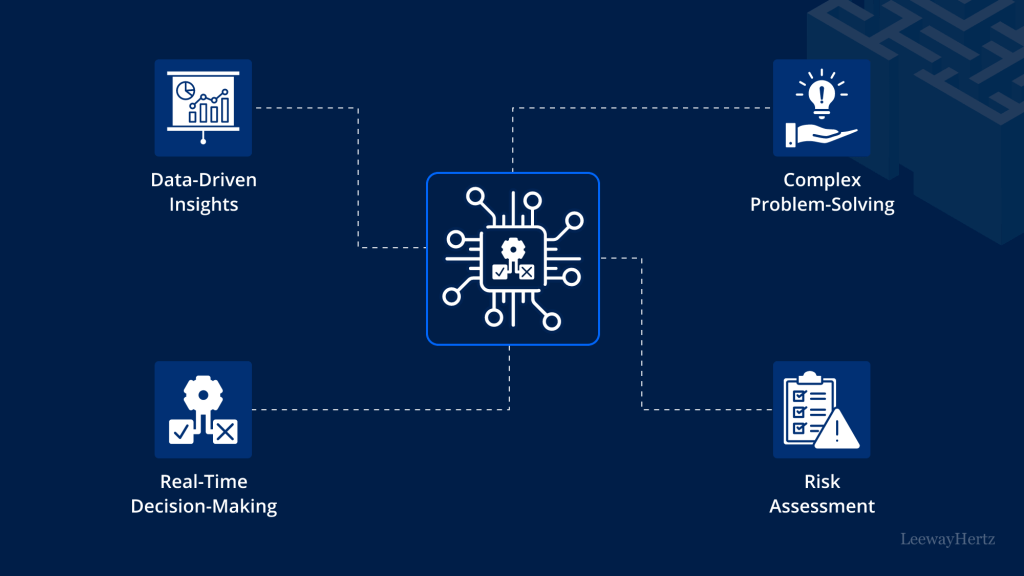
- Data-Driven Insights: AI processes vast datasets to extract meaningful insights, enabling data-driven decision-making.
- Automated Decision Support Systems: AI automates routine decisions, freeing up human resources for more complex tasks.
- Risk Assessment and Mitigation: AI models analyze risks and provide strategies for risk mitigation, ensuring proactive decision-making.
- Real-Time Decision-Making: AI processes information in real-time, allowing businesses to respond swiftly to changing circumstances.
- Complex Problem-Solving: AI excels at solving complex problems by analyzing multiple variables and scenarios.
How AI Aids Businesses in Making Informed Decisions
AI technologies contribute to informed decision-making by providing accurate predictions, identifying patterns, and automating routine tasks. By leveraging AI capabilities, businesses gain a competitive advantage and adapt more quickly to dynamic market conditions.
AI Technologies Used in Decision-Making
Machine learning, natural language processing, and predictive analytics are key AI technologies employed in decision-making processes. These technologies enable businesses to analyze data, identify trends, and make predictions that guide strategic choices.
Different Phases of AI Implementation in Decision-Making
The implementation of AI in decision-making involves planning, integration, and continuous refinement. Businesses must align AI initiatives with their goals, integrate AI tools seamlessly into existing processes, and regularly update and optimize AI models for improved performance.
The Future Impact of AI in Decision-Making
As AI technologies continue to evolve, the future impact on decision-making is poised to be transformative. The integration of AI in decision-making processes will become even more sophisticated, offering businesses unprecedented insights and efficiency gains.
In conclusion, the marriage of smart decision-making and AI is paramount for achieving business success in the contemporary landscape. The diverse applications of AI across industries, coupled with innovative platforms like LeewayHertz’s generative AI, underscore the transformative potential of artificial intelligence in shaping the future of decision-making. Embracing AI technologies empowers businesses to make informed choices, stay ahead of the competition, and thrive in an ever-evolving business environment.
 LeewayHertz