In the dynamic landscape of modern business, efficient inventory management has become a critical component for sustaining growth and ensuring customer satisfaction. In this overview, we’ll explore the importance of streamlined inventory processes, the challenges faced by traditional systems, and the transformative impact of artificial intelligence (AI) on inventory management.
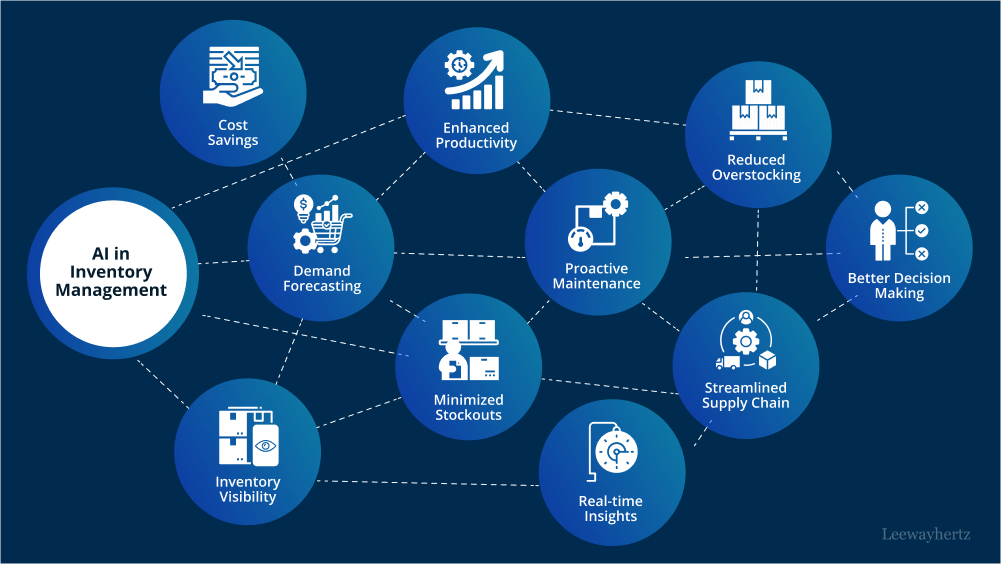
Importance of Efficient Inventory Management for Businesses:
Effective inventory management is the heartbeat of any successful business. It enables organizations to meet customer demand promptly, reduce carrying costs, and minimize the risk of stockouts or overstock situations. Optimized inventory levels lead to improved cash flow, enhanced profitability, and heightened customer satisfaction.
Challenges and Complexities Faced by Traditional Inventory Management Systems:
Traditional inventory management systems often grapple with manual errors, time-consuming processes, and insufficient data analysis capabilities. These challenges can result in inaccurate demand forecasting, delayed order fulfillment, and increased carrying costs, ultimately impacting a company’s bottom line.
Ways to Use AI in Inventory Management:
Artificial intelligence offers a transformative solution to the challenges posed by traditional inventory management systems. Machine learning algorithms and data analytics can automate and optimize various aspects of inventory control, ranging from demand forecasting to order replenishment.
Use Cases of AI in Inventory Management:
AI is revolutionizing inventory management through use cases such as demand forecasting, predictive analytics, and order optimization. Machine learning algorithms analyze historical data to predict future demand accurately, ensuring businesses maintain optimal stock levels and reduce the risk of stockouts or overstock situations.
LeewayHertz’s Generative AI Platform Streamlining Inventory Management Workflows:
LeewayHertz’s generative AI platform takes inventory management to the next level by leveraging advanced algorithms. The platform automates routine tasks, provides real-time insights, and enables businesses to make data-driven decisions swiftly. Its user-friendly interface ensures seamless integration with existing systems, fostering a smoother transition to AI-powered inventory management.
Advanced AI Technologies and Techniques Used in Inventory Management:
AI technologies like machine learning, natural language processing, and computer vision are employed to enhance inventory accuracy, automate processes, and improve decision-making. These technologies enable businesses to adapt rapidly to market changes, optimize supply chain processes, and reduce operational costs.
From Prediction to Precision: How AI Empowers Inventory Management for Major Corporations:
Major corporations are leveraging AI to move beyond traditional forecasting methods. AI empowers organizations to predict customer preferences accurately, optimize warehouse operations, and ensure precise inventory levels. This shift from prediction to precision enables businesses to maintain a competitive edge in the market.
AI in Inventory Management: Future Trends and Scope:
As technology continues to advance, the future of AI in inventory management holds exciting possibilities. Integrating AI with the Internet of Things (IoT) and blockchain technology could further enhance supply chain visibility, traceability, and overall efficiency. Additionally, continuous advancements in AI algorithms will lead to even more sophisticated models for demand forecasting and inventory optimization.
In conclusion, AI is reshaping the landscape of inventory management, offering businesses a competitive edge through enhanced efficiency and precision. LeewayHertz’s generative AI platform exemplifies the potential of AI in transforming inventory workflows. As we look towards the future, the integration of AI with emerging technologies holds the promise of further revolutionizing how businesses manage their inventories.
 LeewayHertz