Financial regulatory compliance is a crucial aspect of the financial industry, ensuring adherence to laws, regulations, and standards set by governing bodies. With the increasing complexity of regulatory requirements and the growing volume of financial transactions, traditional compliance methods are often inadequate. This article provides an overview of financial regulatory compliance, highlights the need for AI integration, explores the benefits of AI in this context, and showcases real-world examples of organizations leveraging AI for compliance.
A Brief Overview of Financial Regulatory Compliance
Financial regulatory compliance refers to the processes and procedures that financial institutions must follow to adhere to laws and regulations governing their operations. These regulations are designed to protect investors, maintain market integrity, and prevent financial crimes such as money laundering and fraud. Compliance requirements vary by jurisdiction and can be complex, requiring extensive resources and expertise to navigate effectively.
The Need for AI in Financial Compliance
The sheer volume and complexity of financial transactions make manual compliance processes time-consuming, error-prone, and resource-intensive. AI offers a solution by automating and enhancing various compliance tasks, enabling financial institutions to improve efficiency, accuracy, and effectiveness in meeting regulatory obligations.
Benefits of AI in Financial Compliance
- Automated Transaction Monitoring: AI algorithms can analyze vast amounts of transaction data in real-time, flagging suspicious activities and potential compliance violations.
- KYC (Know Your Customer) Verification: AI-powered solutions streamline the KYC process by automating identity verification, screening for sanctions and politically exposed persons (PEPs), and flagging high-risk customers.
- Risk Assessment and Mitigation: AI models can assess and quantify risks associated with financial transactions and portfolios, helping institutions identify and mitigate potential risks more effectively.
- Fraud Detection and Prevention: AI algorithms can detect patterns indicative of fraudulent activities, enabling proactive intervention and prevention of financial crimes.
- Regulatory Text Analysis: AI-powered natural language processing (NLP) tools can parse and analyze regulatory texts, helping institutions stay updated on changing regulations and ensure compliance with applicable laws.
- Streamlining Compliance Workflows: AI-driven automation streamlines compliance workflows, reducing manual effort and allowing compliance teams to focus on more strategic tasks.
LeewayHertz’s Generative AI Platform Enhancing Financial Regulatory Compliance Workflows
LeewayHertz’s generative AI platform offers advanced capabilities for enhancing financial regulatory compliance workflows. By leveraging generative AI, the platform automates compliance tasks, provides real-time insights, and improves decision-making, enabling financial institutions to streamline their compliance processes and stay ahead of regulatory requirements.
AI Technologies in Financial Regulatory Compliance
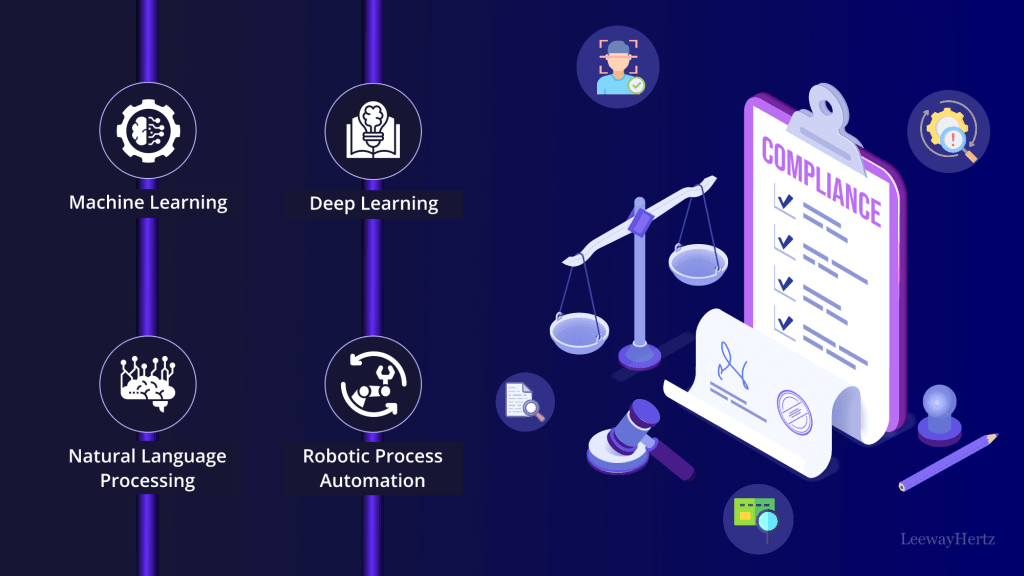
AI technologies such as machine learning, natural language processing, and predictive analytics are instrumental in financial regulatory compliance. These technologies enable institutions to analyze large volumes of data, detect patterns, and make predictions that support compliance efforts.
Real-World Examples of Organizations Harnessing AI for Financial Regulatory Compliance
Several organizations have embraced AI to enhance their compliance capabilities. For example, banks and financial institutions use AI-powered transaction monitoring systems to detect suspicious activities and comply with anti-money laundering (AML) regulations. Similarly, insurance companies utilize AI-driven fraud detection solutions to prevent fraudulent claims and ensure compliance with industry regulations.
AI for Financial Regulatory Compliance: Future Trends
Looking ahead, the adoption of AI in financial regulatory compliance is expected to continue growing. Future trends may include advancements in AI technology, such as the integration of explainable AI to enhance transparency and accountability in compliance processes. Additionally, regulatory authorities may increasingly rely on AI-driven analytics to monitor and enforce compliance across the financial industry.
In conclusion, AI is revolutionizing financial regulatory compliance by offering automated solutions that enhance efficiency, accuracy, and effectiveness. As financial institutions face mounting regulatory pressures, leveraging AI technologies becomes imperative for staying compliant while maintaining competitive advantage. By embracing AI-powered solutions, organizations can streamline their compliance workflows, mitigate risks, and navigate regulatory complexities more effectively.
 LeewayHertz