In today’s rapidly evolving digital landscape, the rise of artificial intelligence (AI) has become a formidable ally in the fight against fraud. As traditional approaches to fraud detection struggle to keep pace with increasingly sophisticated schemes, AI offers innovative solutions that enhance detection capabilities and mitigate risks. This article explores the emergence of AI in fraud detection, its techniques, benefits, and diverse applications across industries.
Traditional Approaches to Fraud Detection
Traditionally, fraud detection relied on rule-based systems and anomaly detection methods. Rule-based systems operate on predefined rules to flag transactions that deviate from established patterns, while anomaly detection methods identify outliers in data that may indicate fraudulent activity.
Limitations of Traditional Approaches
While traditional approaches have been effective to some extent, they are limited in their ability to adapt to evolving fraud tactics and detect subtle patterns indicative of fraudulent behavior. As fraudsters become more sophisticated, traditional methods struggle to keep pace, leading to higher rates of false positives and missed fraudulent activities.
Importance of Fraud Detection in Today’s Digital Landscape
In today’s interconnected world, where financial transactions, online interactions, and data exchanges are ubiquitous, the importance of fraud detection cannot be overstated. Fraud not only results in financial losses but also damages trust, undermines security, and erodes customer confidence. Effective fraud detection is essential for safeguarding businesses, consumers, and the integrity of digital ecosystems.
Common Types of Fraud AI Can Detect
AI-powered fraud detection systems can identify various types of fraud, including identity theft, payment fraud, account takeover, insurance fraud, and cyberattacks such as phishing and malware schemes. By analyzing vast amounts of data and detecting subtle patterns, AI can uncover fraudulent activities that may go unnoticed by traditional methods.
How Does AI Work in Fraud Detection?
AI utilizes advanced machine learning algorithms to analyze large datasets, identify patterns, and detect anomalies indicative of fraudulent behavior. By continuously learning from new data and adapting to emerging threats, AI-powered fraud detection systems can stay ahead of fraudsters and effectively mitigate risks.
AI Techniques for Fraud Detection
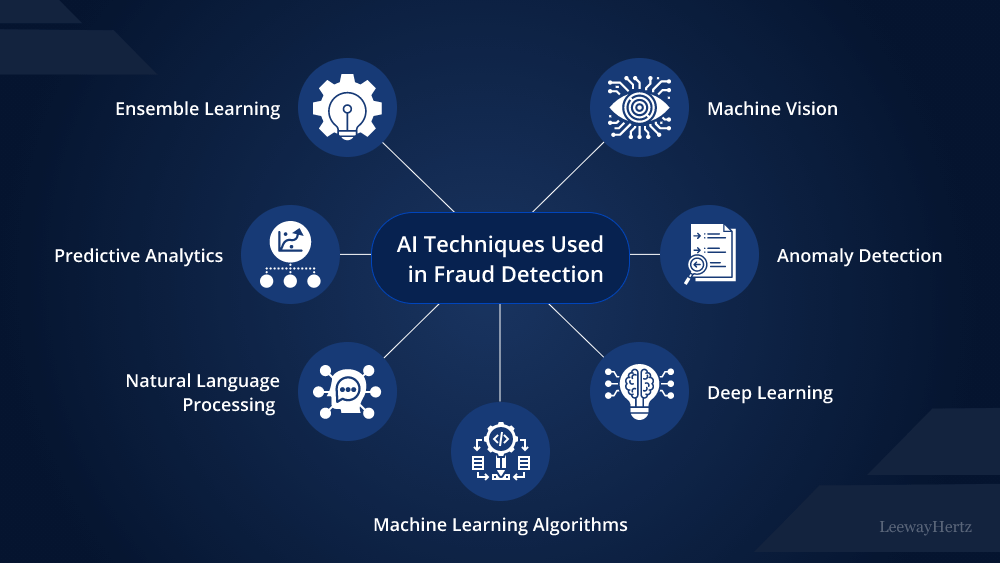
AI techniques employed in fraud detection include supervised learning, unsupervised learning, and deep learning. Supervised learning algorithms learn from labeled data to classify transactions as either fraudulent or legitimate, while unsupervised learning algorithms identify anomalies without the need for labeled data. Deep learning algorithms, inspired by the structure and function of the human brain, enable the detection of complex patterns and relationships in data.
Benefits of Using AI for Fraud Detection
The benefits of using AI for fraud detection are manifold. AI-powered systems offer enhanced accuracy, reduced false positives, real-time detection capabilities, and scalability to handle large volumes of data. By automating the detection process and providing actionable insights, AI streamlines fraud detection efforts and enables proactive risk management.
Use Cases of AI in Fraud Detection Across Diverse Industries
AI is widely used in fraud detection across diverse industries, including banking and finance, e-commerce, healthcare, insurance, and telecommunications. In banking and finance, AI-powered systems detect fraudulent transactions and prevent unauthorized access to accounts. In e-commerce, AI analyzes user behavior to detect fraudulent activities such as account takeovers and payment fraud. In healthcare, AI identifies fraudulent insurance claims and prescription fraud, while in telecommunications, AI detects fraudulent activities such as SIM card cloning and subscription fraud.
In conclusion, the rise of AI in fraud detection represents a paradigm shift in the fight against fraud. With its advanced capabilities, AI offers a proactive and effective approach to combating evolving threats in today’s digital landscape. By harnessing the power of AI, businesses and organizations can enhance their fraud detection efforts, protect against financial losses, and safeguard the trust and security of their customers.
 LeewayHertz