In the realm of finance, credit scoring plays a pivotal role in assessing the creditworthiness of individuals and businesses. Traditionally, credit scoring has relied on predetermined metrics and statistical models to evaluate risk. However, the advent of artificial intelligence (AI) has revolutionized this process, introducing advanced algorithms that enhance accuracy and efficiency. This article explores the concept of credit scoring, the integration of AI, and the transformative impact it has on risk assessment and financial decision-making.
Understanding Credit Scoring and Its Key Metrics
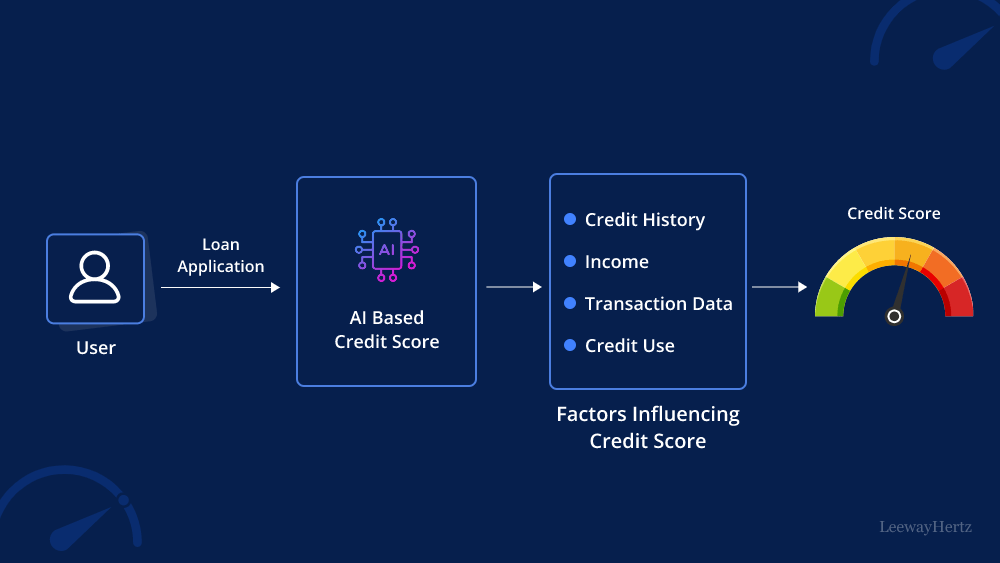
Credit scoring is a method used by lenders to evaluate the credit risk of potential borrowers. It involves analyzing various factors, such as credit history, debt-to-income ratio, payment history, and length of credit history, to determine the likelihood of default. Key metrics used in credit scoring include credit utilization, payment history, length of credit history, new credit accounts, and credit mix.
AI-Based Credit Scoring: A Game-Changer in Risk Assessment
AI-based credit scoring leverages machine learning algorithms to analyze vast amounts of data and identify patterns that traditional models may overlook. By incorporating alternative data sources and dynamic variables, AI enhances the accuracy of risk assessment, enabling lenders to make more informed lending decisions.
How AI-Based Credit Scoring Works
AI-based credit scoring works by training machine learning models on historical data to predict creditworthiness. These models learn from past patterns and behaviors, continuously improving their accuracy over time. By analyzing a wide range of factors, including non-traditional data such as social media activity and online purchasing behavior, AI-based credit scoring provides a more comprehensive evaluation of credit risk.
Enhancing Risk Assessment Through AI in Credit Scoring
AI enhances risk assessment in credit scoring by offering deeper insights into borrower behavior and creditworthiness. By analyzing a broader range of factors and detecting subtle patterns, AI helps lenders identify high-risk borrowers more accurately, leading to better decision-making and reduced default rates.
Types of Credit Scoring Models
Traditional credit scoring models rely on predetermined rules and statistical techniques such as logistic regression. In contrast, advanced credit scoring models, powered by AI, employ machine learning algorithms such as random forests, gradient boosting, and neural networks to analyze complex data and predict credit risk more accurately.
Use Cases of AI-Based Credit Scoring
AI-based credit scoring finds application across various domains within the financial sector, including:
- Calculating Loan Interest Rates: AI analyzes borrower data to determine appropriate interest rates based on credit risk.
- Credit Card Approvals and Limits: AI assesses creditworthiness to approve credit card applications and determine credit limits.
- Business Loan Approvals: AI evaluates the financial health of businesses to facilitate loan approvals.
- Insurance Premium Determination: AI predicts risk factors to calculate insurance premiums accurately.
- Risk Management and Portfolio Analysis: AI helps financial institutions manage risk and analyze portfolio performance effectively.
- Financial Planning and Counseling: AI provides personalized financial advice based on individual credit profiles and goals.
LeewayHertz’s Generative AI Platform: Enhancing Credit Scoring Workflows
LeewayHertz’s generative AI platform streamlines credit scoring workflows by automating data analysis, model training, and decision-making processes. By leveraging advanced algorithms and real-time data processing, the platform enhances efficiency and accuracy, enabling lenders to make better-informed decisions.
Differences Between Traditional and AI-Based Credit Scoring
Traditional credit scoring relies on predetermined rules and limited data sources, whereas AI-based credit scoring employs advanced algorithms and analyzes a broader range of variables, leading to more accurate risk assessment and decision-making.
Benefits of AI-Based Credit Scoring
The adoption of AI-based credit scoring offers several benefits, including:
- Improved accuracy and predictive power
- Enhanced risk assessment
- Faster decision-making
- Reduction in default rates
- Greater efficiency and scalability
In conclusion, AI-based credit scoring represents a significant advancement in risk assessment and financial decision-making. By harnessing the power of machine learning and big data analytics, lenders can gain deeper insights into credit risk, improve lending practices, and ultimately drive better outcomes for borrowers and lenders alike.
 LeewayHertz