In today’s complex regulatory landscape, adhering to compliance standards is paramount for businesses across various industries. Regulatory compliance ensures that companies operate within legal boundaries, protecting consumers, investors, and the broader economy. However, the traditional approach to compliance management often falls short due to its labor-intensive nature, leading to inefficiencies and increased risk exposure. Enter Compliance 2.0 – the integration of artificial intelligence (AI) into regulatory compliance processes.
What is Regulatory Compliance?
Regulatory compliance refers to the adherence to laws, regulations, guidelines, and specifications relevant to a particular industry or business operation. It encompasses various aspects such as data privacy, financial reporting, product safety, and environmental protection, among others.
Regulatory Compliance Challenges in Various Industries: An Overview
Across industries, businesses encounter unique compliance challenges. Financial institutions face stringent regulations like Anti-Money Laundering (AML) and Know Your Customer (KYC) requirements. Healthcare organizations must comply with patient data protection laws such as HIPAA. Manufacturers must ensure product safety and environmental sustainability. Energy companies navigate complex environmental regulations and safety standards.
Why is AI for Regulatory Compliance an Increasing Need?
The sheer volume and complexity of regulatory requirements make manual compliance processes cumbersome and error-prone. AI offers a solution by automating routine tasks, analyzing vast amounts of data, and providing actionable insights to enhance compliance efforts. As regulations evolve and become more stringent, the demand for AI-driven compliance solutions is on the rise.
Core AI Technologies and Their Applications in Regulatory Compliance
- Machine Learning & Deep Learning: Used for anomaly detection, risk assessment, and pattern recognition.
- Natural Language Processing (NLP): Facilitates the interpretation of regulatory texts, contract analysis, and sentiment analysis.
- Predictive Analytics: Enables forecasting of compliance risks and identification of potential violations.
- Robotic Process Automation (RPA): Automates repetitive tasks such as data entry, report generation, and compliance audits.
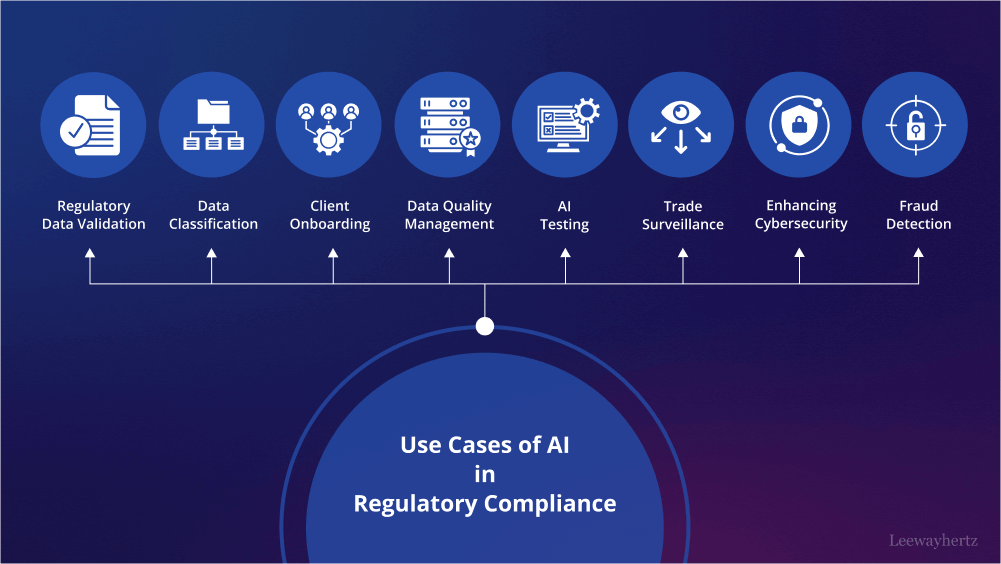
Use Cases of AI for Regulatory Compliance
- Regulatory Change Management: AI helps monitor regulatory updates and assess their impact on business operations.
- Regulatory Data Validation: Ensures accuracy and integrity of compliance-related data through automated validation processes.
- Trade Surveillance: Detects suspicious trading activities and potential market manipulation.
- AI Testing: Streamlines testing processes for compliance software, ensuring reliability and efficiency.
- Data Quality Management: Improves data accuracy, completeness, and consistency for compliance purposes.
- Regulatory Analysis by Supervisory Authorities: Enables regulators to analyze large datasets for monitoring and enforcement purposes.
- Streamlining KYC and Client Onboarding: Accelerates customer due diligence processes while ensuring regulatory compliance.
- Enhancing Cybersecurity and Regulatory Compliance: AI-powered cybersecurity solutions help detect and prevent cyber threats while ensuring compliance with data protection regulations.
- Fraud Detection and Anti-Money Laundering Efforts: Identifies suspicious transactions and potential fraud schemes to mitigate financial risks.
Use Cases of AI in Regulatory Compliance Across Major Industry Verticals
- Financial Services: AI assists in fraud detection, risk management, and regulatory reporting for banks, insurance companies, and investment firms.
- Healthcare: AI-driven solutions enhance patient data privacy, medical billing accuracy, and compliance with healthcare regulations.
- Manufacturing: AI optimizes product quality control, supply chain management, and environmental compliance in manufacturing operations.
- Energy Sector: AI helps energy companies monitor environmental impact, ensure safety compliance, and optimize energy production processes.
Benefits of Using AI for Compliance
Implementing AI for regulatory compliance offers several benefits, including improved efficiency, enhanced accuracy, proactive risk management, cost savings, and better decision-making based on data-driven insights.
Implementation Challenges of AI for Regulatory Compliance
Despite the numerous advantages, implementing AI for compliance comes with challenges such as data privacy concerns, regulatory uncertainty, integration complexities, and the need for skilled personnel.
Best Practices for Deploying AI for Regulatory Compliance
To maximize the benefits of AI in compliance, businesses should prioritize data quality, establish clear governance frameworks, foster collaboration between compliance and technology teams, and continuously monitor and update AI systems to adapt to changing regulatory requirements.
In conclusion, AI is revolutionizing regulatory compliance by offering innovative solutions to address the complexities and challenges faced by businesses across various industries. By leveraging AI technologies effectively, organizations can streamline compliance processes, mitigate risks, and maintain a competitive edge in today’s regulatory environment.
 LeewayHertz