In today’s rapidly evolving industrial landscape, the integration of Artificial Intelligence (AI) has emerged as a transformative force, reshaping traditional manufacturing processes and paving the way for enhanced efficiency, innovation, and competitiveness. From research and development to supply chain optimization, AI is revolutionizing every aspect of the manufacturing workflow. Let’s delve deeper into how AI is revolutionizing manufacturing and explore its key applications, challenges, implementation strategies, and future trends.
What is AI in Manufacturing?
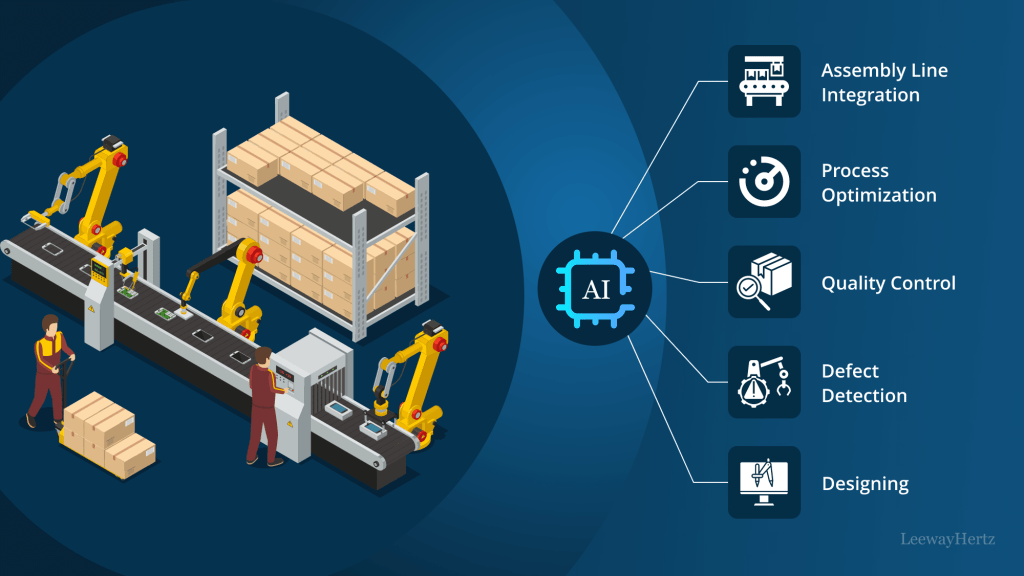
AI in manufacturing refers to the utilization of advanced algorithms and machine learning techniques to automate processes, analyze data, and make intelligent decisions within manufacturing environments. It encompasses a wide array of applications aimed at streamlining operations, improving quality, reducing costs, and driving overall business growth.
AI in Manufacturing: Use Cases Across Various Departments
- Research and Development (R&D): AI enables predictive modeling, simulation, and optimization, expediting product development cycles and fostering innovation.
- Production and Operations: AI-driven predictive maintenance and real-time monitoring optimize production efficiency while minimizing downtime and resource wastage.
- Supply Chain and Logistics: AI enhances supply chain visibility, enabling dynamic demand forecasting, inventory optimization, and efficient logistics management.
- Human Resources and Workforce Management: AI-driven analytics facilitate workforce optimization, talent acquisition, and performance management.
- Sales and Marketing: AI empowers personalized marketing campaigns, sales forecasting, and customer relationship management.
- Finance and Cost Management: AI-driven analytics improve cost visibility, budgeting, and financial decision-making.
- Payroll: AI automates payroll processing, ensuring accuracy and compliance while reducing administrative burden.
AI Use Cases in Manufacturing
AI applications span a broad spectrum, including market trends research, consumer preferences identification, historical data analysis, innovation, defect detection, assembly line integration, predictive analytics, energy management, demand forecasting, and more. These applications drive process optimization, enhance productivity, and enable proactive decision-making across the manufacturing value chain.
How Does AI Address Key Challenges Across the Manufacturing Workflow?
AI addresses challenges such as inefficient processes, quality control issues, supply chain disruptions, and workforce management complexities by leveraging data-driven insights, predictive analytics, and automation technologies. It enables proactive problem-solving, risk mitigation, and continuous improvement, fostering agility and resilience in manufacturing operations.
How Can AI Be Implemented for Enhanced Efficiency and Innovation?
Implementing AI in manufacturing involves identifying critical areas for improvement, selecting suitable AI technologies, integrating with existing systems, and fostering a culture of innovation and collaboration. Leveraging AI for data-driven decision-making, predictive maintenance, and process optimization drives efficiency gains and fosters a culture of continuous improvement and innovation.
AI in Manufacturing: Key Technologies and Techniques
Key AI technologies and techniques include machine learning, deep learning, natural language processing, computer vision, predictive analytics, and robotic process automation. These technologies empower manufacturers to extract actionable insights from vast datasets, automate repetitive tasks, and optimize complex processes for improved performance and competitiveness.
Benefits of AI in Manufacturing
The benefits of AI in manufacturing are manifold, including improved operational efficiency, enhanced product quality, reduced costs, faster time-to-market, increased agility, and better decision-making. By harnessing the power of AI, manufacturers can stay ahead of the curve, drive innovation, and maintain a competitive edge in today’s dynamic marketplace.
Future Trends and Opportunities
Looking ahead, the proliferation of AI use cases in manufacturing is expected to continue, driven by advancements in AI technologies, increased data availability, and evolving customer demands. Key trends include AI-driven robotics, autonomous manufacturing systems, digital twins, and AI-enabled supply chain optimization. Embracing these trends presents exciting opportunities for manufacturers to unlock new levels of efficiency, innovation, and growth.
In conclusion, AI is a game-changer in the manufacturing sector, offering transformative capabilities to drive efficiency, innovation, and competitiveness. By harnessing the power of AI across various departments and workflows, manufacturers can unlock new opportunities, address key challenges, and stay ahead in today’s dynamic business landscape.
 LeewayHertz