In today’s dynamic business landscape, effective project management plays a pivotal role in achieving organizational goals and staying ahead of the competition. As projects become increasingly complex and multifaceted, traditional project management approaches may struggle to keep pace with the demands of modern businesses. However, the integration of Artificial Intelligence (AI) has emerged as a transformative force, empowering project managers to streamline processes, make data-driven decisions, and drive strategic insights like never before.
Understanding Project Management
Project management involves the application of knowledge, skills, tools, and techniques to execute projects effectively and efficiently. Key components include defining project objectives, planning project activities, allocating resources, managing budgets and timelines, monitoring progress, and mitigating risks.
Stages of Project Management
Project management typically comprises several stages, including initiation, planning, execution, monitoring and controlling, and closure. Each stage requires meticulous attention to detail and effective coordination to ensure project success.
Common Challenges in Project Management
Despite meticulous planning, project managers often face challenges such as scope creep, resource constraints, communication breakdowns, and unpredictable risks, which can hinder project progress and impact outcomes.
AI Use Cases in Project Management
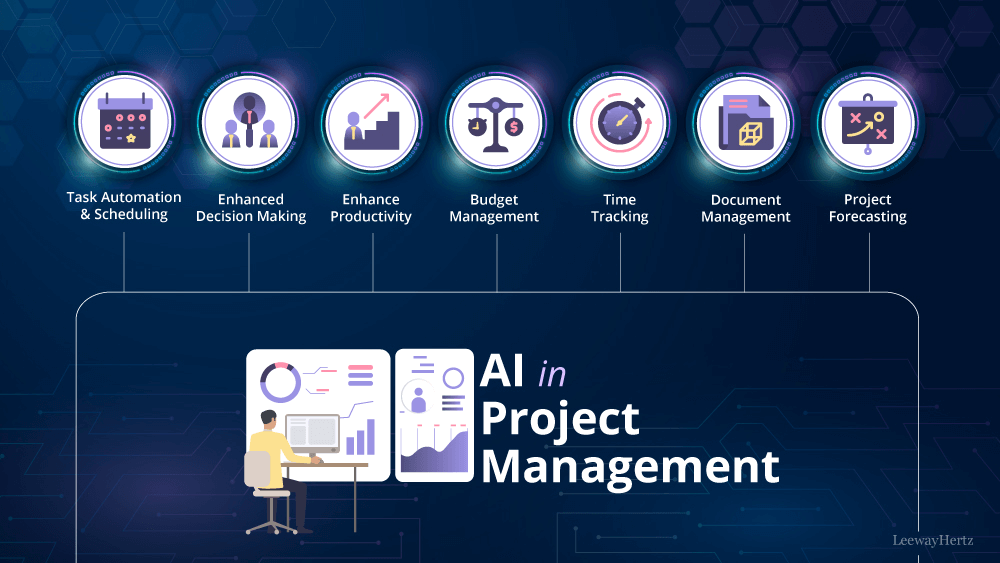
AI offers a plethora of use cases in project management, including:
- Task automation and scheduling
- Enhanced decision-making through data analysis
- Predictive analytics for risk management
- Resource allocation optimization
- Productivity and efficiency enhancement
- Cost estimation and budget management
- Time tracking and performance monitoring
- Stakeholder sentiment analysis
- Document management and knowledge retrieval
- Error reduction and quality improvement
- Project forecasting
Benefits of AI in Project Management
The integration of AI in project management offers several benefits, including improved efficiency, reduced costs, enhanced decision-making capabilities, increased productivity, and better risk management.
Traditional vs. AI-Powered Project Management Approaches
While traditional project management relies on manual processes and human intuition, AI-powered project management harnesses the power of machine learning, natural language processing, and predictive analytics to automate tasks, analyze data, and drive strategic insights.
AI Models and Techniques Used in Project Management
AI models and techniques commonly used in project management include machine learning algorithms for predictive analytics, natural language processing for sentiment analysis, and optimization algorithms for resource allocation.
Future Trends of AI in Project Management
As AI continues to evolve, the future of project management will likely see further integration of AI-driven technologies, such as autonomous project management systems, intelligent virtual assistants, and augmented reality for remote collaboration.
In conclusion, AI holds immense potential to revolutionize project management by enhancing efficiency, enabling data-driven decision-making, and unlocking strategic insights. By embracing AI, organizations can stay agile, adapt to change, and achieve greater success in their projects.
 LeewayHertz